
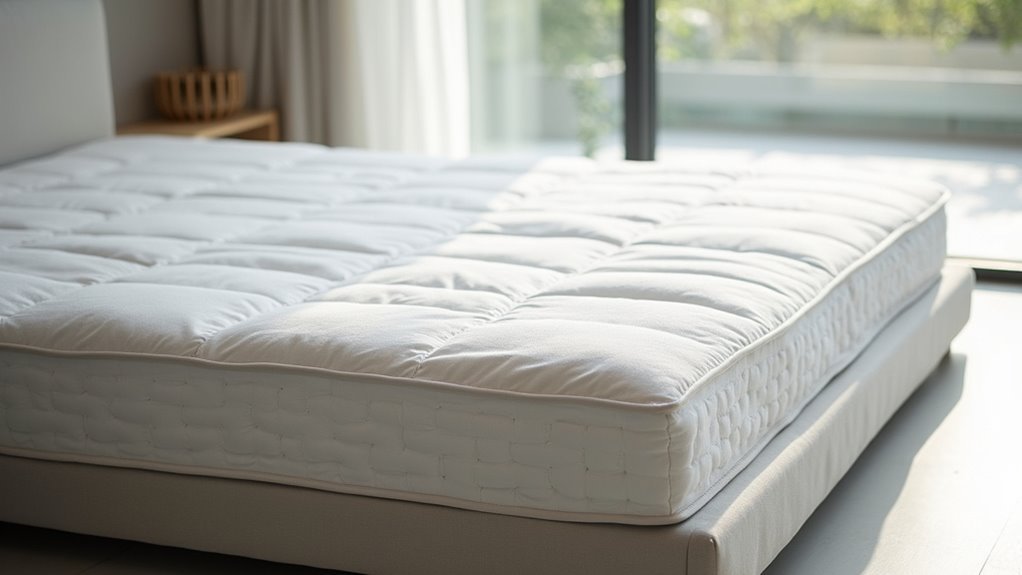

A queen mattress measures 60 inches wide by 80 inches long and offers a balanced mix of space and fit. It suits single sleepers who like extra room and couples who share moderate space. Bedroom size, body dimensions, and sleep habits determine comfort on this bed. Compared with full or king sizes, a queen is a middle ground in both width and price. Knowing exact dimensions helps pick the right mattress and frame for a restful night.
What Are Queen Mattress Dimensions?
A queen mattress measures 60 inches wide and 80 inches long, which makes it one of the easiest sizes to envision and plan around.
You get a roomy sleep space that feels welcoming, whether you sleep alone or share it with someone else.
Because it’s a standard size, you can shop with more confidence and compare options without guessing. That matters whenever you check mattress edge support, since stable edges help you use the full surface without feeling like you’ll slide off.
It also helps to look at sleep trial length, because you deserve time to see whether the size truly fits your body and your room.
With this balance, you can settle in and feel at home.
Queen Mattress Dimensions in Inches and Feet
When you look at queen mattress dimensions in inches and feet, the size is easy to visualize and even easier to plan for. You’re getting 60 inches of width and 80 inches of length, which works out to about 5 feet across and 6 feet 8 inches. That shape gives you room to stretch out without crowding your bedroom.
In case you share the bed, each of you gets about 30 inches of personal space, which feels fair and cozy. Because the size stays consistent across most brands, you can shop with confidence. Also, the depth matters too, since thicker models can affect mattress ventilation and edge support.
With those numbers in mind, you can envision how a queen fits your space and your sleep style.
Queen vs. Full, King, and California King
The easiest way to sort out queen mattress dimensions is to line them up against the other common sizes.
You get more room than a full, since a queen adds 7 inches in width and 5 inches in length. That extra space can improve sleep ergonomics, especially when you share the bed or stretch out at night.
Compared with a king, a queen keeps the same 80-inch length, but it’s 16 inches narrower, so space optimization feels easier without giving up long-leg comfort.
Then, against a California king, you’ll notice the queen is shorter but much wider. So, should you desire a size that feels comfortable, familiar, and easy to live with, queen often sits right in the sweet spot for you.
Will a Queen Fit Your Bedroom?
Before you bring in a queen mattress, check your room’s width, length, and how much space you need to move around it. You’ll also want to leave room for doors, nightstands, and any other furniture so the bed doesn’t crowd the space.
Should your layout feel tight, a few smart placement choices can still make a queen fit comfortably.
Room Size Basics
A queen mattress usually fits well in many bedrooms, but your room size can make a big difference in how open or crowded the space feels.
You’ve got a standard 60 by 80 inch bed, so a 10 by 10 foot room can work, while 10 by 12 feet often feels more comfortable. That extra space helps your bed frame fit better and keeps natural lighting from feeling boxed in.
It also supports smoother traffic flow, so you can move around without bumping into furniture.
Should you share the room, a queen can still feel cozy and balanced, giving each person enough space to rest. Whenever you plan your layout, consider your bed, dresser, and windows together.
That way, your room feels welcoming, calm, and truly yours.
Walking Space Needs
Once you know a queen mattress measures 60 inches across 80 inches, you can start checking how much walking room it will leave around your bed. Aim for at least 24 inches on the sides so you can move without bumping your knees. Should your room feel tight, 18 inches can still work, but it might feel snug.
You’ll also want hallway clearance from the doorway, so sheets, hampers, and sleepy feet don’t collide in the morning. Then check nightstand spacing, because a little gap helps you reach a lamp or phone without crowding your space. A queen often fits well in a 10 by 10 room, yet a 10 by 12 room usually feels calmer. That extra space helps you breathe easier and feel right at home.
Furniture Placement Tips
As you start planning furniture around a queen mattress, the bed itself should guide every other choice in the room. Since it measures 60 across 80 inches, place it initially, then build your layout around calm movement and cozy balance. A queen often fits best in a 10-by-10 or larger room, so you can keep your space feeling shared, not crowded.
| Item | Tip |
|---|---|
| Nightstands | Keep them slim for accessory clearance |
| Lamps | Check lighting placement before you buy |
| Dressers | Leave a clear path to drawers |
Next, match scale to your room. A low bed frame can open the floor, and wall-mounted lights free up surface space. Suppose you’re arranging for two, give each side enough room to feel welcome. Small choices like these help your bedroom feel like yours, not cramped.
Queen Mattress Dimensions for Couples and Solo Sleepers
For most couples and solo sleepers, a queen mattress hits that sweet spot between roomy and practical. You get 60 inches of width and 80 inches of length, so two people usually share about 30 inches each. That space can feel close and cozy without feeling cramped, especially if you value sleep warmth or a privacy preference at night.
In case you slumber alone, you can stretch out, roll over, and still keep room for pillows, pets, or a late-night book. Because queen sizing stays consistent across brands, you can shop with confidence and feel part of the crowd that chooses balance over excess. It also fits most primary bedrooms well, so your room can stay open, calm, and easy to live in.
Standard Queen vs. Olympic Queen
The size difference between a standard queen and an Olympic queen can feel small on paper, but it matters in real life. You get extra width with the Olympic comparison, so your shoulders and elbows won’t feel as crowded. Historical origins matter too, because this less common size grew from older oversized bedding needs.
| Size | Width | Length |
|---|---|---|
| Standard queen | 60 in | 80 in |
| Olympic queen | 66 in | 80 in |
| Extra room | 6 in | 0 in |
| Best for | Most bedrooms | Wider sleep space |
| Feel | Balanced | Roomier |
Should you and your partner want a cozier fit, the standard queen works well. In case you crave a little more breathing room, the Olympic queen can feel like a small upgrade that helps you rest easier together.
RV, Short Queen, and Split Queen Sizes
Provided that a standard queen still feels a little too roomy or a little too narrow for your setup, RV, short queen, and split queen sizes can give you more practical choices.
Whenever you travel in an RV, an RV queen usually fits better because it trims length while keeping familiar width, so you can sleep without crowding the cabin.
A short queen works the same way in many compact bedrooms, giving you queen comfort in a tighter footprint.
In case you share a bed but want easier moving and setup, a Split queen lets you use two matching halves that align neatly.
You get flexibility, and your space feels more like yours.
That small adjustment can make bedtime feel calmer, cozier, and easier to love.
How Thick Should a Queen Mattress Be?
Whenever you choose a queen mattress, thickness matters just as much as width and length because it shapes how the bed feels and fits with your base.
You’ll usually want a height that gives you solid support and enough comfort without making it hard to get in and out of bed.
As you ponder bedding, frame height, and your sleep style, the right mattress depth can help your queen bed feel just right.
Ideal Mattress Height
A queen mattress usually feels best once it has enough height to support you well and still fit your bedroom without crowding it.
You’ll often do well with 10 to 14 inches, because that range gives you solid Ideal loft and supports Sleep ergonomics.
In case you like a softer, more cushioned feel, a slightly taller mattress can help you settle in with ease.
Should you want a cleaner, lower profile, a slimmer height can still feel comfortable.
What matters most is how the mattress matches your body, your bed frame, and the way you move at night.
Whenever the height feels right, your room feels calmer, and you can rest like you belong there.
Choose the height that helps you feel supported, settled, and at home.
Base And Bedding
Choosing the right thickness for your queen mattress starts with the base and the bedding, because both can change how the bed feels and fits in your room. Provided you use box springs, check that the mattress depth works with the frame, since thicker beds can sit higher and make climbing in feel awkward.
A low platform can suit a slimmer mattress, while a taller base could look better with a deeper one. Then consider your sheets and mattress protectors, because deep-pocket bedding needs to match the full height, not just the queen width and length.
Whenever everything lines up, your bed looks neat, feels welcoming, and belongs in your space. That small fit check can save you from loose corners, bunching, and late-night sheet wrestling.
Support And Comfort
- You feel hugged, not stuck.
- Your back stays steady and calm.
- You share space without feeling crowded.
- You wake up feeling like you belong in your bed.
Should you sleep on your side, a thicker bed can ease shoulders and hips. Should you sleep on your back, a firmer core can keep you level. So, pick the height that matches how you rest.
Queen Bed Frame and Foundation Size
For your queen mattress to feel right, the frame and foundation need to match its 60-inch across and 80-inch in length size with care. You want a base that gives full support, so your bed feels steady and inviting every night.
Look for a queen frame with solid wood slatwork, since slats that sit close together help spread weight well. Also check corner reinforcement, because strong corners keep the frame from wobbling when you climb in after a long day.
Should you use a box spring or platform foundation, make sure it measures for queen size too. A good fit leaves no gaps, no overhang, and no awkward squeeze. That way, your bedroom feels calm, and your bed feels like it truly belongs.
Queen Bedding Sizes
Soft layers matter as your queen bed starts to come together, because the right bedding makes a 60 by 80 inch mattress feel smooth, snug, and easy to live with.
You want queen sheets that match the mattress depth, so the corners stay put and your bed feels cared for.
- Flat sheets give you a soft, shared surface
- Fitted sheets hug the mattress with less slipping
- Seasonal sheets help you stay cozy or cool
- Fabric durability keeps your set feeling welcoming longer
When you choose pillowcases and blankets in queen size, you build a space that feels like yours.
In the event you sleep with someone, the extra width gives both of you room to settle in.
Even one person gets that wraparound comfort that says, “you belong here.”
How to Measure Your Room Before Buying
Before you bring a queen mattress home, you should measure your room so the bed fits without crowding your life. Start with the wall space, then check the path in and out. Use this quick guide:
| What to check | Why it matters |
|---|---|
| Room length | Lets the 80-inch mattress fit |
| Room width | Leaves walking space on both sides |
| Measure doorways | Confirms the bed can enter |
| closet clearance | Keeps doors and drawers usable |
Next, mark the mattress footprint on the floor with tape. A queen is 60 by 80 inches, but a frame could add a few inches. Should you share the room, keep room for nightstands and easy movement. That little extra space can make your bedroom feel calm, open, and truly yours.
Frequently Asked Questions
How Much Floor Space Does a Queen Mattress Occupy?
You’ll use about 33.3 square feet of floor footprint, or 4,800 square inches, for a queen mattress. That size can support your room layout beautifully, giving you comfort while still preserving space for belongings.
Are Queen Mattress Dimensions the Same Across All Brands?
Not always, but you will usually find standard sizes across brands, with only small regional variations. You can expect a queen to stay close to 60 by 80 inches, though frames and thickness might differ.
What Is the Weight of a Queen Mattress?
You’ll usually handle 50 to 120 pounds, depending on mattress materials. Foam models feel lighter; innerspring and hybrid ones weigh more. Factor this into delivery logistics so you’ll feel ready and included.
How Many Sheets Fit a Queen Mattress?
You’ll usually need one queen sheet set: a fitted sheet, a flat sheet, and two pillowcases. Choose thread count and fabric types that feel like home so you and your bed stay cozy together.
Can Two Adults Comfortably Share a Queen Mattress?
Yes, you can, but comfort varies; as they say, “good things come in pairs.” You will likely enjoy better sleep quality provided you both sleep calmly, though movement transfer can still disturb sensitive sleepers.
