
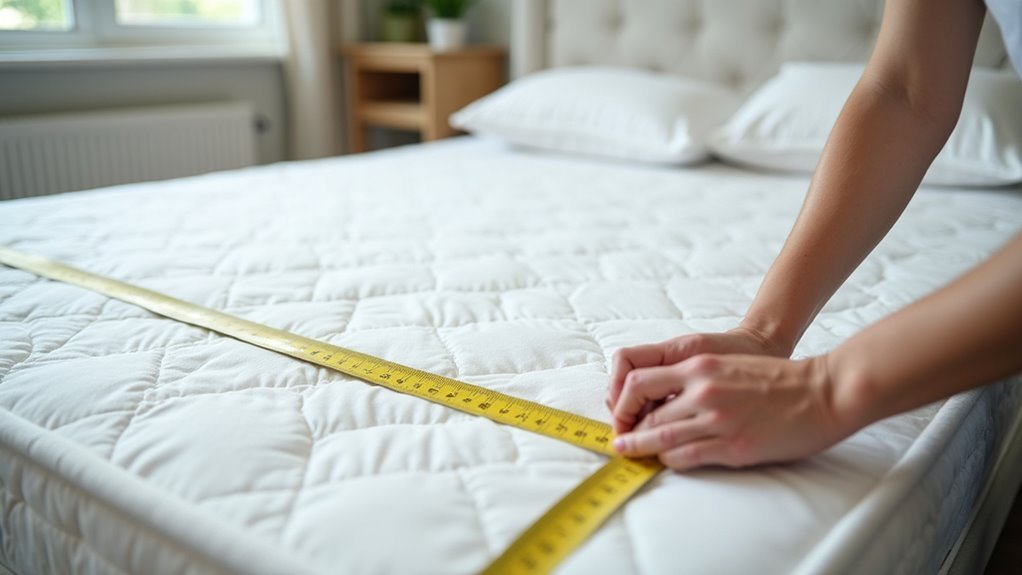

Measuring a mattress correctly prevents ill-fitting sheets and frames. Use a flat surface and a reliable tape measure to get true length, width, and thickness. Identify the mattress edges by smoothing any fabric and pressing down to find the seam lines. Account for pillowtop layers by measuring at the tallest and flattest points. Write down each dimension and double-check before buying sheets or a bed frame.
What You Need to Measure a Mattress
Before you start measuring a mattress, gather a few simple tools so the job feels easy and accurate. You’ll need a tape measure, a flat floor or firm platform, and a pen with paper or your phone for quick notes.
Take off all bedding to begin, then check that the mattress sits still and doesn’t sink. This helps you get clean results and protects material compatibility when you’re planning for a frame, protector, or replacement pad.
A second person can steady the tape on larger beds, which makes the process less frustrating. Keep your space clear so you can move around the bed without stress.
Good prep also helps with delivery logistics, since exact measurements make ordering and fitting much smoother for you.
Measure Mattress Length and Width
Start measuring from edge to edge so you get the true length and width of your mattress.
Keep the tape measure straight across the center, because a curved line can throw off the numbers.
Then write down each exact dimension right away so you don’t second-guess yourself later.
Measure From Edge To Edge
To get a true mattress size, measure from edge to edge across the full length and width, not just the part you sleep on. This helps you trust the numbers and feel at home with the fit. Check edge alignment so your tape meets the outer seams cleanly, then read the full span for perimeter accuracy.
| What you measure | Why it matters |
|---|---|
| Head to foot | Confirms the real length |
| Left to right | Confirms the real width |
When the mattress has rounded corners or a thick border, stay with the outer edge, not the soft center. That way, you won’t end up buying sheets that play hide and seek. Measure both sides provided the shape looks uneven, and use the widest and longest points. Write each number right away so your mattress details stay clear and easy to share.
Use A Straight Tape
A straight tape measure gives you the cleanest read on mattress length and width, especially after you’ve already checked the outer edges. Set it flat from head to foot, then from side to side, and keep your tape placement centered so the line stays true.
That simple measurement technique helps you avoid the tiny bends and dips that can throw off a size by a little or a lot. In case the mattress feels wide or oddly shaped, don’t rush. Hold the tape snug, but not tight, so you follow the real edge without pulling it crooked.
Whenever you measure this way, you’re doing the same careful step as everyone who wants a fit that feels right, whether you’re matching sheets, frames, or just making sure your bed belongs in the room.
Record Exact Dimensions
Lock in the mattress’s exact length and width now, because this is the part that keeps the rest of your measurements honest.
You want to measure from the center, not the edge, so the numbers reflect the real size your bed frame needs.
Keep the tape straight from head to foot for length, then across left to right for width.
Write each number down right away, and keep the units the same.
In case the mattress has a tag or care label, check it, but trust your own reading initially.
This helps whenever you compare beds, plan transport logistics, or order a new frame with confidence.
Should the shape be odd, use the widest and longest points, and let that guide your choice.
Measure Mattress Thickness
To measure mattress thickness, place your tape from the bottom surface to the top surface and keep it straight.
Make sure you include pillow tops, padding, and any cording, since those extra layers count too.
Should the mattress feels a little bulky, that’s okay, you’re just measuring its true height, not giving it a spa day.
Top To Bottom
At the time you measure mattress thickness, start from the bottom and work your way up to the top surface so you get a true depth reading. Put the mattress on a flat floor, then keep the tape straight at the center. This helps you keep vertical alignment and makes the number feel right, not guessed.
Should you’re checking fit, thickness also matters for headboard clearance, so measure carefully before you buy sheets or a frame. Use a ruler or tape measure and observe the tallest point if the surface isn’t even. You don’t need fancy tools, just a steady hand and a little patience.
That way, you’ll feel confident your mattress matches your space and your sleep setup.
Include Pillow Tops
Pillow tops can change the whole story whenever you measure mattress thickness, so don’t stop at the firm base underneath. You need to include every soft layer, because pillow top compression can hide the true height. Press the surface only enough to keep the mattress natural, then measure from the floor to the highest point with a straight edge or tape measure.
Should you own a removable pillowtop, check whether it’s attached before you measure, since a loose layer can make the mattress seem shorter or taller than it really is. Take the reading at the center, then verify it near the corners if the shape shifts. Whenever you count the top padding, you get a size that fits your space and helps you feel sure about your choice.
Measure a Mattress for Sheets
Getting the right sheet size starts with an accurate mattress measurement, and that small step can save you a lot of frustration later. Measure the length, width, and elastic depth before you shop, because sheets need to fit your bed, not fight it.
| Check | What to look for |
|---|---|
| Length | Match the mattress head to foot |
| Width | Cover the full sleeping surface |
| Elastic depth | Fit over the full side wall |
| Corner gap | Leave enough room for smooth tucking |
| Fabric stretch | Keep the sheet snug, not strained |
When you know your numbers, you can compare thread count and fit with confidence. That makes choosing sheets feel easier, and you’ll sleep better in a bed that feels truly yours.
Measure a Mattress for a Bed Frame
A mattress that fits your sheets well still needs to match the bed frame just as closely, because a frame that’s too small or too large can throw off the whole setup.
You want frame compatibility, so strip off bedding and measure the mattress on a flat floor. Check the length and width from the center, then note the thickness, since some frames need extra room for a taller build.
Next, compare your numbers with the inside frame size, not just the label on the package. Also watch clearance requirements around headboards, rails, and footboards, because tight spots can pinch the mattress or leave gaps.
Should you share a room, this step helps everything feel settled and secure, like it finally belongs there.
Measure a Mattress for a Protector
Start measuring your mattress’s length, width, and thickness so you know the exact size a protector needs.
Then check those numbers against the protector’s label, because even a small mismatch can lead to bunching, slipping, or a cover that won’t stay in place.
Once you match the mattress dimensions to the protector fit, you make bedtime easier and protect your mattress the way you want.
Mattress Dimensions
Measuring your mattress for a protector could feel like a small chore, but it matters more than you’d envision. You want the right dimensions so your bed feels neat and cared for, and so mattress ergonomics and material durability stay protected.
To begin, strip off every layer and place the mattress on a flat floor or firm frame. Then measure from the center for length, width, and thickness, since edges can lie to you a little. Keep the tape straight from head to foot, then side to side, and include any pillow top in the depth. Record each number right away, using the same units each time.
Should your mattress have a strange shape, take the longest and widest points so your protector matches your bed comfortably.
Protector Fit Check
Once you know your mattress size, the next step is making sure the protector fits like it should, because a snug cover can save you from bunching, slipping, and a lot of little annoyances later. You want a protector that hugs the corners without stretching too hard.
| Check | What to look for |
|---|---|
| Fit | Smooth edges, no loose fabric |
| Depth | Matches your mattress height |
| Finish | Strong seams and elastic retention |
After you slip it on, press along the sides and corners. Should it shift, size up or try a deeper pocket. Then do quick waterproof evaluation with a few drops on the surface and watch for leaks. Once the cover stays put and the fabric rebounds well, you’re set for that cozy, secure feel everyone wants.
Measure an Irregular Mattress Shape
Irregular mattresses can feel tricky at initially, but you’re still get a solid measurement provided you stay calm and work from the widest and longest points.
Start by laying the mattress flat and clearing off every cover, then use contour mapping to spot the full shape.
Next, run a tape measure through the center for length, and then across the broadest part for width.
Should the edges curve or dip, use perimeter tracing with a second person so the tape stays snug and straight.
After that, check thickness at the center and near any higher spots.
Write each number right away so nothing slips away.
With careful steps, you’ll capture the real size and feel ready, not stuck guessing.
Compare Your Mattress to Standard Sizes
Now that you have your mattress measurements, the next step is to compare them with standard sizes so you can see where it really fits. This bed size comparison helps you match your bed to a twin, full, queen, king, or California king with confidence.
Start by checking length, width, and depth against size charts from trusted mattress marketplaces. Should your mattress land between two sizes, you’ll know why bedding or frames could feel a little off.
You’re not guessing anymore, and that can feel like joining the right club. Also, use the closest standard size as your guide while shopping, since labels can vary a bit. With clear numbers, you can select a better fit and feel more at home in your space.
Common Mattress Measuring Mistakes
Even careful measuring can go off track should you miss a few easy mistakes, and that’s more common than you might suppose. You’re not alone when the numbers feel slippery to begin with.
- Don’t measure with bedding still on. It can hide the real edge and add bulk.
- Skip soft surfaces. A sagging frame bends your tape and changes the result.
- Watch corner alignment. When you start on a seam or angle the tape, you’ll miss the true length or width.
- Check for fabric shrinkage or stretching, especially on older beds, since the cover can shift the size a little.
How to Measure a Mattress in the Box
Should your mattress is still in the box, you can save yourself a lot of guesswork before checking the package size prior to you open it. That’s handy during compressed shipping and online unboxing, whenever the carton gives you the initial clue.
| Box check | What you note |
|---|---|
| Length | Compare the printed length with your room plan |
| Width | Make sure it fits doors and hallways |
| Height | Watch for extra space in closets |
| Weight | Check whether you’ll need a helper |
Then you can measure the sealed box with a tape measure. Keep it flat, read the numbers at the longest side, and trust the label too. In case the box feels tight, don’t force it. You’re part of a smart crowd, and careful checking helps you feel ready, calm, and welcome before the big reveal.
How to Record Mattress Measurements
Write down each mattress measurement right away so the numbers stay clear and easy to trust. You’ll feel more confident whenever you keep one simple record that matches your home’s needs. Use a notebook, phone note, or spreadsheet, then add the date, unit, and any special shape details.
- List length, width, and thickness in the same order every time.
- Note where you measured, such as the center or widest point.
- Save photos of tags, seams, or corners for backup.
- Add the figures to maintenance logs so future checks stay neat.
If you plan storage tips later, these notes help you choose the right cover or space without guesswork. Clear records make you feel part of a smart, prepared group, and they keep surprises small.
When to Recheck Mattress Size
You should recheck your mattress size whenever something changes its shape, feel, or fit, because a mattress can shift a little over time without you noticing right away.
Do this after moving, after seasonal checks, and any time you rotate or flip it.
Fresh air, new rooms, and different humidity can change how it rests on the frame.
So can new bedding, a topper, or a repaired support base.
Should you share the bed, ask someone to help you measure so you both feel confident in the result.
Keep the mattress bare, flat, and fully settled before you check it again.
That way, you stay in sync with your space and avoid surprises whenever you need a better fit.
Signs Your Mattress Size Is Off
A mattress can quietly drift out of size, and the clues usually show up in everyday life initially. Should you feel cramped, wake up hanging off one side, or notice edge misalignment with your bed frame, your mattress could be off. You might also see cover puckering, loose corners, or gaps that let pillows slip down.
- Your feet press the frame.
- Your shoulders crowd the edge.
- Sheets won’t stay smooth.
- The mattress shifts when you turn.
These signs matter because a wrong fit can steal comfort and make your room feel less like yours. Once you spot them, check the dimensions soon. A quick remeasure can help you get back to a sleep setup that feels steady, safe, and truly yours.
Frequently Asked Questions
How Do I Measure a Mattress With a Pillow Top?
Measure a pillow top by placing it flat, then measuring length, width, and measuring depth from bottom to the highest point without pillow top compression. You will get accurate sizing and feel confident selecting the right fit.
Should I Measure a Mattress in Inches or Centimeters?
You should measure in inches if that is your usual standard, but centimeters offer metric advantages for precision and easy comparisons. Choose one unit, keep it consistent, and you will fit right in with any sizing guide.
Can One Person Measure a King-Size Mattress Accurately?
Yes, you can, but even Hercules had help; your measuring technique works best with visual aids, a firm surface, and careful tape control. You will get close alone, yet a second person enhances accuracy and confidence.
How Do I Measure a Split Mattress Correctly?
Measure each split section separately on a flat surface, then compare both pieces and observe the seam lines. Use matching foundations should you join them, and keep your tape straight so you get consistent, accurate dimensions.
What if My Mattress Label Size Differs From My Measurements?
If your mattress label differs from your measurements, it is likely a normal size variance. You are not alone. Check your tape method, note how much the size differs, and contact the manufacturer if the difference is unusually large.
